

How Does Chiropractic Work?
July 31, 2026
Can a Chiropractor help with Tension Headaches?
August 10, 2026
The discomfort in the lower back may make you feel tired at the end of the day, make it challenging to fall asleep, or make you feel exhausted in the morning. While lying in bed for the first time, you can feel at ease, but then you might get up in the morning with stiffness, tightness, and sudden pain.
Once you understand how to sleep with lower back pain, your spine will not have to bear as much of the weight as it would, and your muscles will be able to rest at night. Using the correct sleep position, mattress support, and pillow position can make a significant difference.
But sleeping positions are not effective for everyone. The cause and site of your pain could determine the best position for you. This guide will help you take care of your lower back to get a more comfortable sleep.
Why Does Lower Back Pain Get Worse at Night?
Lower back pain can get worse during the night because it is a period of time when you are in the same position. Embedded in an unsupportive position, the muscles, joints, discs, and ligaments around the spine can be stressed.
Your pain can also be worse at night as there are fewer distractions compared to the day. Other possible reasons are:
- Poor spinal alignment
- Too soft or firm a mattress
- Incorrect pillow placement
- Tight muscles
- Kidney Stones
- A difficulty in sleeping position.
- The flexibility of movement is decreased at night.
- A pre-existing low back or joint problem
The objective is to have your head, shoulders, hips and spine as naturally aligned as possible. This neutral sleep position may help to decrease tension in the low back and other muscles.
What is the best sleeping position with lower back pain?
For lower back pain, the ideal sleeping positions tend to be those that maintain the normal curves of your back without twisting your hips or pelvis. Many find it easier to sleep on the back or side, rather than on their stomach.
It might take some trial and error to find a position that’s most comfortable and which pillow set offers the best relief.
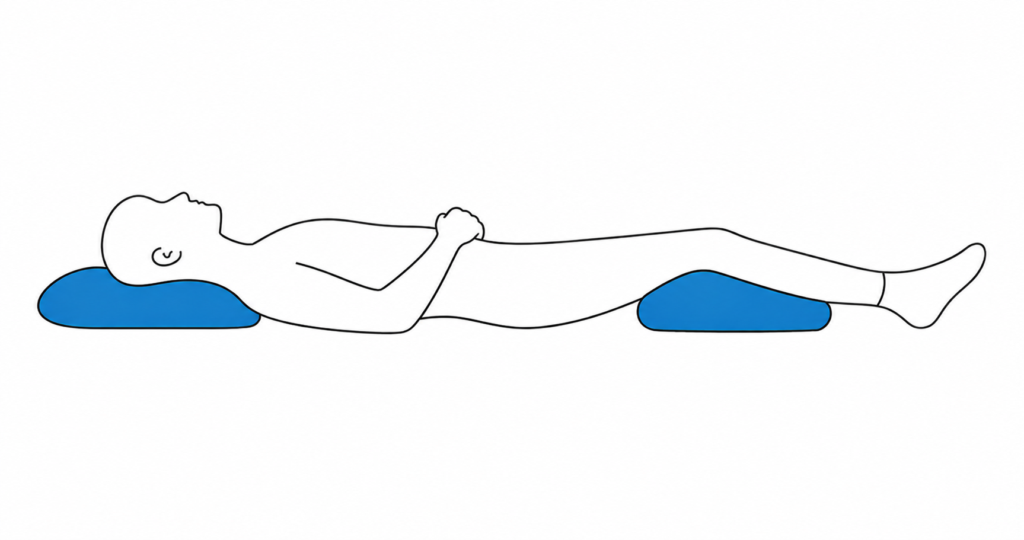
1. Sleep on Your Back with a Pillow Under Your Knees.
Lying on your back can distribute your weight evenly over the mattress. It is also a means to distribute pressure equally between the two sides of your body.
The position can be made more comfortable by:
- Stretch out, spread-eagle, and flat on your back.
- Use a supportive pillow to place under your knees.
- Maintain comfort of the neck with a good pillow.
- Let shoulders and arms drop down to their normal positions.
Your legs are bent slightly due to the pillow under your knees. This can aid in relieving the tension within the lower-back muscles and also maintain the curvature of the lumbar spine.
A few individuals also prefer to put a little rolled towel under the waist. It should be supportive, but not too tight.
2. Sleep on the Side, with a pillow between the knees.
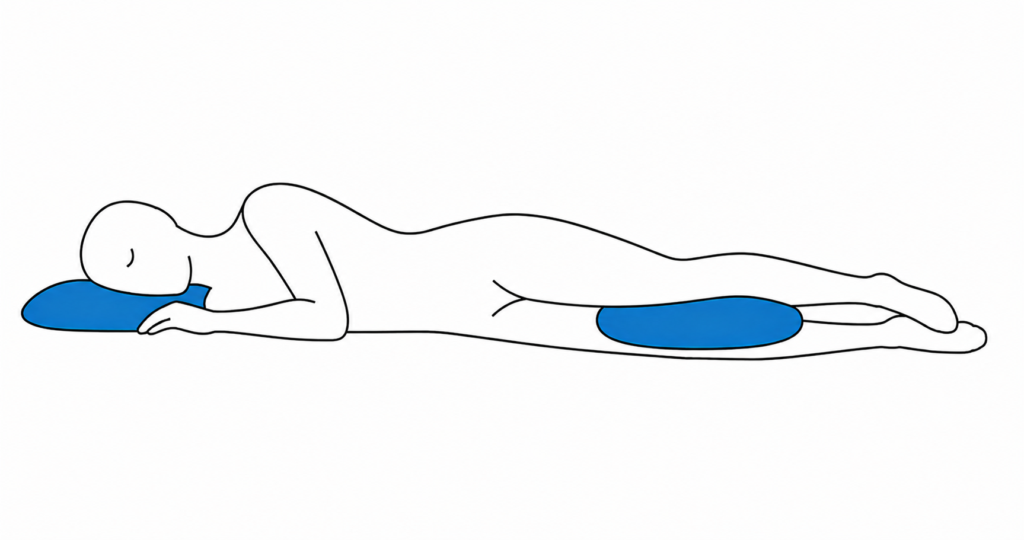
Another sleeping position that is comfortable for many with lower back pain is on their side. However, during sleep your upper leg may drop forward, rotating your pelvis and twisting your lower spine.
Using a pillow between your knees will help to maintain your hip, pelvis and spine in line.
To have a good posture when lying on your side:
- Slightly bend knees.
- Maintain a fairly straight posture.
- Lift the knees with a firm pillow.
- Wear a head pillow that will maintain the level of the neck.
- Do not roll tightly into a ball.
If you have a full-size body pillow, you can use that to make sure that your body doesn’t turn while you sleep.
A flexed knee position may feel comfortable, but may be extremely flexed, resulting in stiffness or excess strain on the neck and back.
Should You Put a Pillow Under Your Lower Back?
Some people may find it easier to sleep on a pillow under their lower back, but for others it is not comfortable or suitable. A too-thick pillow can accentuate the curve of the spine and make it more uncomfortable.
Instead of using a full-sized pillow, consider using:
- A thin pillow that supports the lumbar spine.
- A small scrolled-up towel.
- A soft cushion for supporting the body.
The support should go along the line between your waist and mattress, snugly, but should not stretch your back. If pain gets worse, discontinue use.
3. Practice the Reclined Sleeping Position:
Others prefer to sleep in a propped-up position. This might be useful if it is more uncomfortable to lie flat.
Use the following to make a reclined position:
- An adjustable bed
- A wedge pillow
- Use pillows for support behind upper body
- A great chair with back and neck support
Ensure that your body is well supported and you are not bending too far over at the waist. The objective is to maintain support of the spine and to develop a smooth angle.
Why Do I Have Back Pain When Lying on My Stomach?
If you’re asking this question, it means you’re not alone. If you’re asking yourself the question, “Why does my back hurt when I lay on my stomach?” you’re not alone. The pain may be felt due to the pressure of the abdomen and pelvis on the lower back, creating the natural curve of the back to be accentuated.
Breathing into your head can also cause your upper neck to turn if your spine is flat. This posture can cause a strain of muscles and joints over hours.
If you’re unable to sleep on your back, experiment with putting a thin pillow under your hips and lower abdomen. This could take some of the strain out of your lower back. Depending on what makes your neck feel comfortable, you might need a thin pillow, if any, underneath your head.
When you have lower back pain, how should I sleep?
If you’re asking the question “How should I sleep with lower back pain?” keep in mind that it isn’t only your sleeping position; your entire sleep setup is important.
Here are some practical suggestions:
Maintain a Consistent Sleep Schedule
Eating regular meals and going to sleep and getting up around the same time every day could help improve your sleep habits. With improved sleep quality, it should be easier to cope with discomfort.
Don’t do Sudden Twisting in Bed.
When flipping over, see if you can keep your shoulders and hips together. Twisting your upper body away from the pelvis can cause pain in the lower back.
Get Out of Bed Carefully
Rather than sitting up straight:
- Turn to your side.
- Turn your legs over the end of the bed.
- Use arm power to get into a sitting position.
- Stand slowly, maintaining the support of your back.
This method helps to minimize the shock to the lower spine from rapid bending and twisting.
Check Your Mattress
You should feel the mattress supporting you, but not sinking any deeper than your hips. A very soft mattress can cause the spine to be out of alignment, and a very hard mattress can cause pressure points.
Before replacing your mattress, take your body type, sleeping position, and pain pattern into account and keep in mind that comfort is subjective.
When Should You Seek Professional Help?
Some back pain can be relieved by altering activities, sleeping positions, and providing proper home care. If the pain persists or intensifies, however, it’s important to seek professional help.
If the lower back pain persists and you experience any of the following, get immediate medical attention:
- Incontinence (loss of bladder or bowel control)
- Paresthesias around the groin or inner thighs
- Strong hip weakness, one or both legs
- Fever
- Unexplained weight loss
- A fall or accident that causes severe pain.
- Waking up at night many times with pain.
- Persistent pain, increasing in severity
Changes in sleep position alone may not be sufficient to alleviate these symptoms and may need medical evaluation.
Can a Chiropractor Help with Lower Back Pain?
Your chiropractor for lower back pain will assess your posture, spinal mobility, lifestyle, and symptoms. Treatment may involve chiropractic manual therapy techniques, mobility advice, supportive exercises, and suggestions for daily body mechanics.
Patients at Wang Family Chiropractic can have a personalized assessment, so they can better understand some of the things that might be causing them to feel discomfort. All recommendations should consider your symptoms, health history, and physical examination.
This doesn’t work for everyone, and sometimes chronic or debilitating symptoms need to be coordinated with another health care practitioner.
Final Thoughts
The first step towards sleeping with lower back pain is to maintain a proper alignment of the spine and avoid sleeping in certain positions that put pressure or strain on it.
Sleeping with a pillow under the knees or sleeping on the side with a pillow between the legs are most convenient choices for many. Stomach sleepers will not be as supported, although a thin pillow under the hips can be beneficial if it means you can move into a different sleeping position.
When lower back pain is ongoing and is affecting your quality of sleep, mobility, or happiness, talk to Wang Family Chiropractic to arrange an evaluation and discuss the best care plan for you.